 / Product catalogue / Domestic ventilation / Residential axial fans / AC or DC: Which Motor Is Better for a Residential Fan?
When choosing a fan for the bathroom, restroom, or kitchen, we usually look at performance, noise level, and price. But there’s another feature that affects daily use: the type of motor.
AC and EC motors are used in residential fans. Both types perform their tasks well, but they differ in power consumption, speed control capabilities, and operational features.
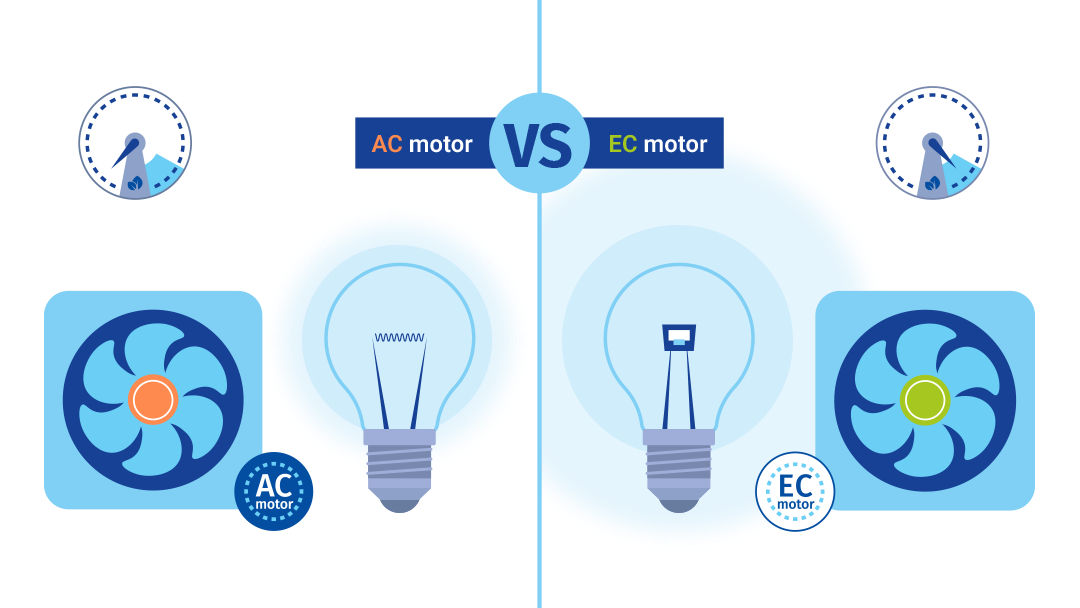
If we compare them to light sources, an AC motor could be roughly compared to a standard light bulb, whereas an EC motor would be like an LED. Both fulfill their function, but an LED typically consumes less electricity while providing the same brightness. EC motors offer a similar advantage: for the same performance, an EC fan can consume significantly less electricity compared to an AC fan.
 Lower Power Consumption
One of the biggest advantages of an EC motor is its reduced power use. It enables the fan to deliver the required airflow with lower energy consumption compared to a similar AC motor.
This is especially important when the fan runs for many hours a day. Say, in a bathroom, you might want to maintain constant background ventilation rather than turning on the fan only once you've finished showering. In this mode, even a difference of a few watts gradually adds up to noticeable savings.
| Specification | Blauberg Q-Matic 100 | Blauberg Trio One EC |
| Motor type | АС | EС |
| Maximum airflow | 90 m³/h | 95 m³/h |
| Power consumption | 10 W | 3 W |
| Air duct diameter | 100 mm | 100 mm |
Note: Data is provided according to Blauberg’s official technical documentation.
According to the specifications, the Trio One EC’s power consumption is 3 W, compared to 10 W for the Q-Matic, which is 70% less. If you run both fans for 8 hours a day for a year, the EC model will consume ca. 8.76 kWh, while the AC model will consume 29.2 kWh. The difference will amount to 20.44 kWh per year.
Annual savings formula:
(AC power − EC power) × operating time per year ÷ 1,000 × rate per 1 kWh.
 Automation of Fan Operation
Ventilation is not always needed at the same intensity. For example, after a shower, it’s important to remove moist air quickly, but once the humidity has dropped, the need for intensive ventilation decreases.
In some models, fan operation can be automated using extra features:
 Humidity sensor. It turns on the fan or changes its operating mode depending on the humidity level.
 Timer. It allows the fan to continue running for a set period after the power is cut off.
 Motion sensor. It ensures the fan turns on automatically when motion is detected.
These options may be available in both EC-motor models and AC fans. Their availability depends on the specific model and control system.
 Reliability and Durability
The high efficiency of EC motors implies that the motor converts electrical current into useful work rather than heat. Since EC motors typically generate less heat than comparable AC models, the thermal load on the windings and bearings is also lower. This creates favorable conditions for long-term continuous operation.
 For example, the Blauberg Flyn Still EC series fans use maintenance-free ball bearings: according to the series’ datasheet, their grease supply is sufficient for 40,000 hours of continuous operation. That’s approximately 4.5 years straight. However, it’s important to note that the actual service life depends on the model and operating conditions, so please refer to the specific fan’s user’s manual for exact data.
 Do EC Motors Have Any Drawbacks?

 An EC fan will work best if:
 An AC fan will work best if:
Both technologies offer certain advantages. It’s important not just to choose a more modern motor, but to find a fan that matches the room’s use, the desired performance, and your budget.


 We are in social networks