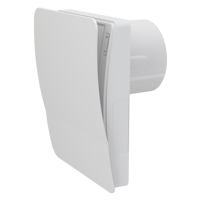
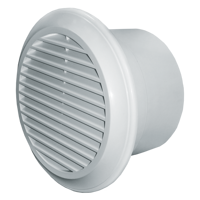
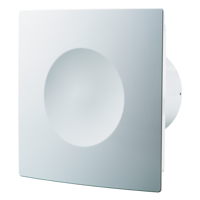
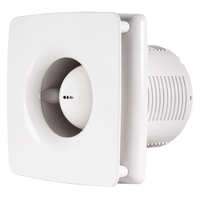
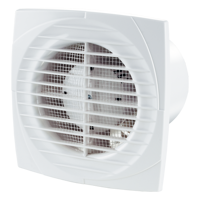
Poor ventilation leads to stuffiness, condensation, mould, excess humidity and lingering odours, which is why a quality extractor fan is an essential element of a comfortable indoor climate. A bathroom exhaust fan forcibly removes stale air through a ventilation duct in the wall, ceiling or window, ensuring steady air exchange where natural ventilation isn’t enough.
The technical name for bathroom exhaust fans is residential axial fans. During operation, the impeller of such a device moves air along its own axis of rotation. These models are compact, easy to install, economical and well suited to short ventilation ducts, particularly in bathrooms, WCs and shower rooms.
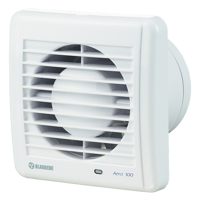
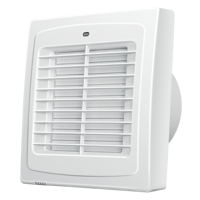
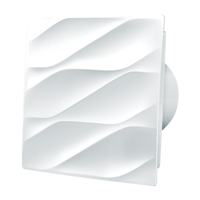
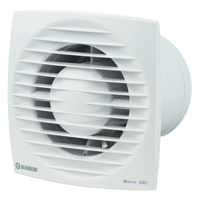
This section presents Blauberg fans for the bathroom, including low-noise models with energy-efficient DC motors, humidity sensors, timers and smart control. Functionality and design vary by collection: Smart, Design or Classic. Blauberg products are available through an international network of official distributors and authorised partners.
A bathroom extractor fan is an axial fan for extraction, with a capacity sized for small rooms. The device removes humid and polluted air from the room and helps maintain steady air exchange in bathrooms, WCs and shower rooms. An extractor fan bathroom is especially needed when natural ventilation isn’t enough: the room feels stuffy, and humidity and odours linger.
Blauberg bathroom vent fans can be installed in a ventilation opening in the wall, ceiling or window, and can also be used for air duct ventilation. All design features, installation methods and technical specifications can be reviewed in the technical documentation (available to download on the product pages).
Bathrooms, shower rooms and toilets — especially those without windows — are spaces where a lot of moisture, steam and odours build up. An exhaust fan bathroom helps quickly remove these pollutants through the ventilation duct, replacing stale air with cleaner, fresher air drawn from adjacent rooms. This improves air exchange not only in the bathroom or WC, but throughout the whole home.
If air exchange in a room is insufficient, condensation forms on mirrors, walls and the ceiling. When moisture doesn’t evaporate quickly enough, mould develops over time, paint peels, furniture swells, and finishes are damaged.
A bathroom extractor fan is chosen according to room size, the ventilation layout and everyday usage conditions. The catalogue offers both small extractor fans with airflow from 33 m³/h for compact bathrooms (for example, Flyn Still EC) and higher-capacity models for more intensive air removal, including the Blauberg Sileo series for larger rooms.
The Classic collection includes the Sileo, Aero, Bravo, Q-Matic and Trio series — standard extractor fans designed for use in residential ventilation systems.
The Smart collection includes the O2 and Smart series, which stand out for their app-based smart control, sensors and automated ventilation.
The Design collection includes the Flyn, Sileo Design, Cabrio, Bavaria, Hi-Fi and other series — modern bathroom fans with decorative front panels and a strong focus on design.
The bathroom exhaust fan size is selected according to the diameter of the air duct. In addition, to choose the right extractor fan you need to calculate its capacity correctly. For this, you need to know the room volume and the appropriate air change rate.
The basic formula for calculating the toilet exhaust fan size is: room length × width × height × air changes per hour. For bathrooms, a coefficient of 6–8 is generally used.
| Room type and typical size | Recommended air changes | Required airflow |
| Small toilet, approx. 1.5 × 1.2 × 2.5 m | 6–8 times/h | 27–36 m³/h or 16–21 CFM |
| Standard bathroom, approx. 2 × 2 × 2.5 m | 6–8 times/h | 60–80 m³/h or 35–47 CFM |
| Large bathroom / wet room, approx. 3 × 3 × 2.5 m | 6–8 times/h | 135–180 m³/h or 79–106 CFM |
A toilet extractor fan or shower model is selected for a specific room, humidity level and usage scenario. When choosing, it’s important to consider not only capacity but also a model’s additional functions.
If you’re choosing a shower extractor fan, it’s critical to pay attention to its IP rating. In addition, for this scenario the most convenient models are those with a humidity sensor that switch on automatically while you shower.
An exhaust fan for toilet should have sufficient capacity and provide an air change rate of 8–10 times/h, so it can quickly remove odours and ventilate the room briefly after use. It’s also worth considering models with an overrun timer, which keep running for a set time after the light is switched off.
For a combined bathroom/WC, it’s best to choose a versatile toilet fan extractor with a set of sensors and other convenient features.
What is a bathroom fan?
A bathroom exhaust fan is an axial fan that removes stale air from the bathroom and helps prevent condensation, mould and unpleasant odours.
What size extractor fan do I need for my bathroom?
To determine the required capacity of a bathroom fan extractor, multiply the room volume by an air change coefficient of 6–8. For a standard bathroom, a model of around 100 m³/h, or about 60 CFM, is usually sufficient.
Can I install an extractor fan in a shower?
Yes, but a shower extractor fan must match the installation zone and have an appropriate IP rating. For Zone 1 — that is, inside the shower area — you should use a model certified for that zone, for example the Blauberg extractor fan Bavaria One.
Are DC bathroom fans better than AC?
DC fans are usually more energy-efficient and quieter than AC models. They are well suited to bathrooms where the unit runs for several hours a day.
How does a bathroom ventilation fan with a humidity sensor work?
The humidity sensor automatically switches on the exhaust fan bathroom when the moisture level in the air rises — for example, while you shower. When humidity drops back to a normal level, the fan switches off.
Are Blauberg bathroom vent fans quiet?
Yes — many Blauberg residential axial fans, including the Sileo and Blume series, are designed for quiet operation. The exact noise level in dB(A) is stated in the technical documents for each specific model.